Friday, March 16, 2018

King (Hong) Kong

King Kong would have been happy in Hong Kong.  This is another city of soaring buildings, both office and residential, in a variety of colors.  It gives a new meaning to high density housing, since the average apartment is fewer square feet than the interior of our tour buses.


Our welcome party consisted of  a junkue and a fire-boat squirting water.


With a day and a half in Hong Kong, we chose the Cultural Hong Kong tour for the first day, leaving the second day for exploration on our own.

Our first stop was a temple that served Buddhism, Confusion-ism and Taoism.  I understand that if you come to Hong Kong and belong to any of thee religions, a visit to this temple is almost mandatory.  I believe it from the number of people there.  Vendors were selling or giving away, I'm not sure which, incense stick to the faithful.  Correspondingly, there were money collection boxes scattered around the temple so people could make a donation to help keep up the temple.  The main room was dark and no one was allowed past the door, so I do not know what it was like, but many people were standing outside inclining their heads rhythmically while holding the incense sticks.  After a while, they stood the sticks up in containers or on sand.  The result was a thick haze of incense. 

There were people from three different religious groups, but everyone got along.  Perhaps there is a lesson there.
The Horse
Yoda, anyone?


In the courtyard, there were larger than life statures of the 12 astronomical symbols.  This is the year of the dog.  Darrell & I were born in the year of the horse.


The next stop was the Walled City Park.  The wall was not a high wall which would not keep anyone out.  At one time, this wall defined the city.  As the city grew, the buildings became higher, looking more like shipping containers stacked up.  there was a thriving economy within the walls.  However, with overcrowding came corruption, gambling , drugs and other vices to the point where police were afraid to enter the area.  Refugees fleeing the Japanese when they invaded China before World War II increased the population.  After the Japanese surrendered, lawlessness continued until the government could no longer allow it to continue.
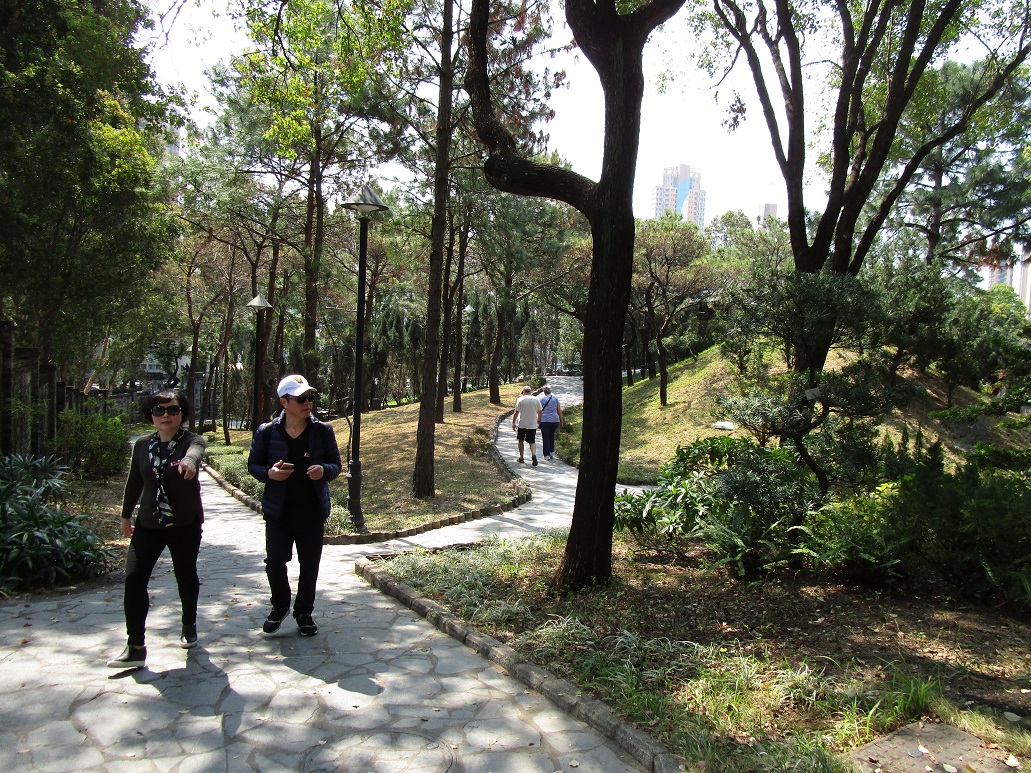


People were moved out and the buildings destroyed.  The whole area became a park, one of the few places in the city where you can walk or run, have picnics and generally enjoy the out of doors.  I will not say you can enjoy fresh air, because the pollution prevents that.


Hong Kong has suffered many natural disasters, including typhoons, droughts, tropical rains, fires and landslides.  Areas susceptible to land slides have been stabilized.  Fire is strictly regulated.  There is not much you can do about typhoons and droughts.


Our last stop was the Hong Kong Museum.  It is not so much a museum as a walk through time, starting before human habitation and continuing on 4 floors of walk-through scenes and exhibits of life in various times.  As an example, the WWII section has small rooms with video interviews of people who lived through it as well as newsreels prepared by the Japanese to show how well they were treating the people,  In contrast, the true conditions were also shown.  For the early history, each of the 4 main ethnic groups had a life-size scene showing traditions and celebration.  It is one of the most educational and entertaining  museums I have ever seen.  Unfortunately, they do not allow pictures, so you will just have to come and visit it for yourself.

Tuesday, March 13, 2018

We've Been Shanghai'd

Our two days in Shanghai were full days.

Shanghai Museum

The Shanghai Museum is a modern building with 4 floors of exhibit halls each consisting of several interlinking rooms and each dedicated to some aspect of Shanghai.  One hall had rooms and rooms of glass cases filled with coins and later, paper money.  Every denomination ever minted was displayed.  The rooms for jade, porcelain, statues, pottery, officials, etc. was just as extensively displayed.  The section on ethnic clothing covered every clan for the last several thousand years.  The main theme of all these rooms seemed to be to show that China covered a lot of territory and has for thousands of years.  Hong Kong and Tibet, among others are not separate places, just more parts of the great country of China.  If I had the concession to provide the glass for all those exhibit cases, I would be rich.

This was called "A thousand Buddhas".
I did not count them.
Shanghai Museum lobby


Everywhere you look there are tall buildings.  Some are offices, but many are government owned housing.  The cost of living is high so most people have to work more than 1 job to be able to afford even the basic government subsidized unit.  One of the most famous places in Shanghai is the Bund, the embankment area where ships used to dock and where the business of trading was conducted.  A tall (of course) monuments is dedicated to those who died in World War II.  Many buildings, including the Custom House and the (Fairmont) Peace Hotel across the street from this open public walkway were built in the 1900's.  The land across the river was once rice fields and shacks.  Now it is the business center with the landmark Television Tower and all the tallest buildings.  Most of these buildings light up at night with changing colored lights in patterns or in ever changing pictures.  When we were here several years ago we watched all this from the Bund and from our hotel which was facing the financial district.  Another part of the show is the steady stream of lighted tour and dinner boats on the river.

Architect who design modern buildings in Shanghai do not believe in straight lines and square buildings.

The Sun Chateau where the Viking Sun Naming Ceremony was held
Although the Viking Sun was launched several months ago, the official naming ceremony was held in Shanghai, probably because the "Godmother" of the ship is a Chinese banker and she arrange major financing for the ship.  We were given the hype about a fantastic ceremony and banquet held on shore.  Sunday best was the dress code.  The actual ceremony was held on shore right beside the ship with a live audience of high ranking officials, light, music, audio visual effects and speeches in Chinese, English and Norwegian.  The big moment began with a "Viking" bringing a large ax onto the stage and handing it to the godmother.  She chopped a ribbon which loosed a bottle of akavit (strong Norwegian booze) to swing against the ship and break. 
Note the "Viking" in the background
What actually happened was that we were bused for 10 minutes to a huge banquet facility, fed mediocre food, watched the show on a medium size TV screen and heard the speeches in all 3 languages at the same time.  Not everyone fit in the main room, so people in the 2 smaller rooms were fed a plated meal instead of the buffet.  After a while when it was clear that everyone had given up on the ceremony, we were told that the buses were ready.  When we got to the door, there were no buses.  The crowd grew and got a bit pushy.  People pushed and shoved onto the first bus with some people standing.  They had to get off because the driver refused to go with people standing.  Fortunately we were on the first bus.  I guess the crowd for buses got bigger and a bit more unruly, so the officials let the people walk back to the ship in 40 degree weather.

Monday, March 12, 2018

The Coldest, the Fastest, the Tallest

When we were in Brisbane, Australia, they were setting record high temperatures.  In Brunei, the temperature was 95 degrees with high humidity.  You could not only feel, but see, the moisture in the air.  Anything in the distance was hazy.  Shanghai, three days later, was 45 degrees when we woke up.  While we were there, some of the nights dropped to near freezing.  There were a couple of good points.  As Minnesotans, we were used to cold weather, so it was not bad.  Also, we brought warm sweaters and jackets.  Although we carried the jackets, we never actually wore them.  The haze, however, could not be explained by the humidity --it was smog, plain and simple, even though the Chinese denied it.  For them, this was normal, the way it always was.

One morning we took the mag-lev train.  I do not understand the principle, but somehow it relies on magnetic attraction/repulsion so it does not actually come in contact with the rails when it is moving.  Thus there is no friction.  We were told it would feel like a jet taking off, but it did not.  Instead, there was steady acceleration until it reached maximum speed of 431 kilometers per hour.  That is somewhere around 260 miles per hour.  Then it steadily slowed down until we reached our destination, the airport.  It was very expensive to build and has little purpose except as a show piece.  Although one end is at the airport, you still have to travel quite a distance from anywhere in the city to get to the other end.  The train had a place in each row of seats to put your carry-on luggage, but it would be hard traveling with more than one piece.  One Caucasian who toured the ship (probably a travel agent) asked how we liked the "Disney World ride."

Model of the
Jin Mao Tower
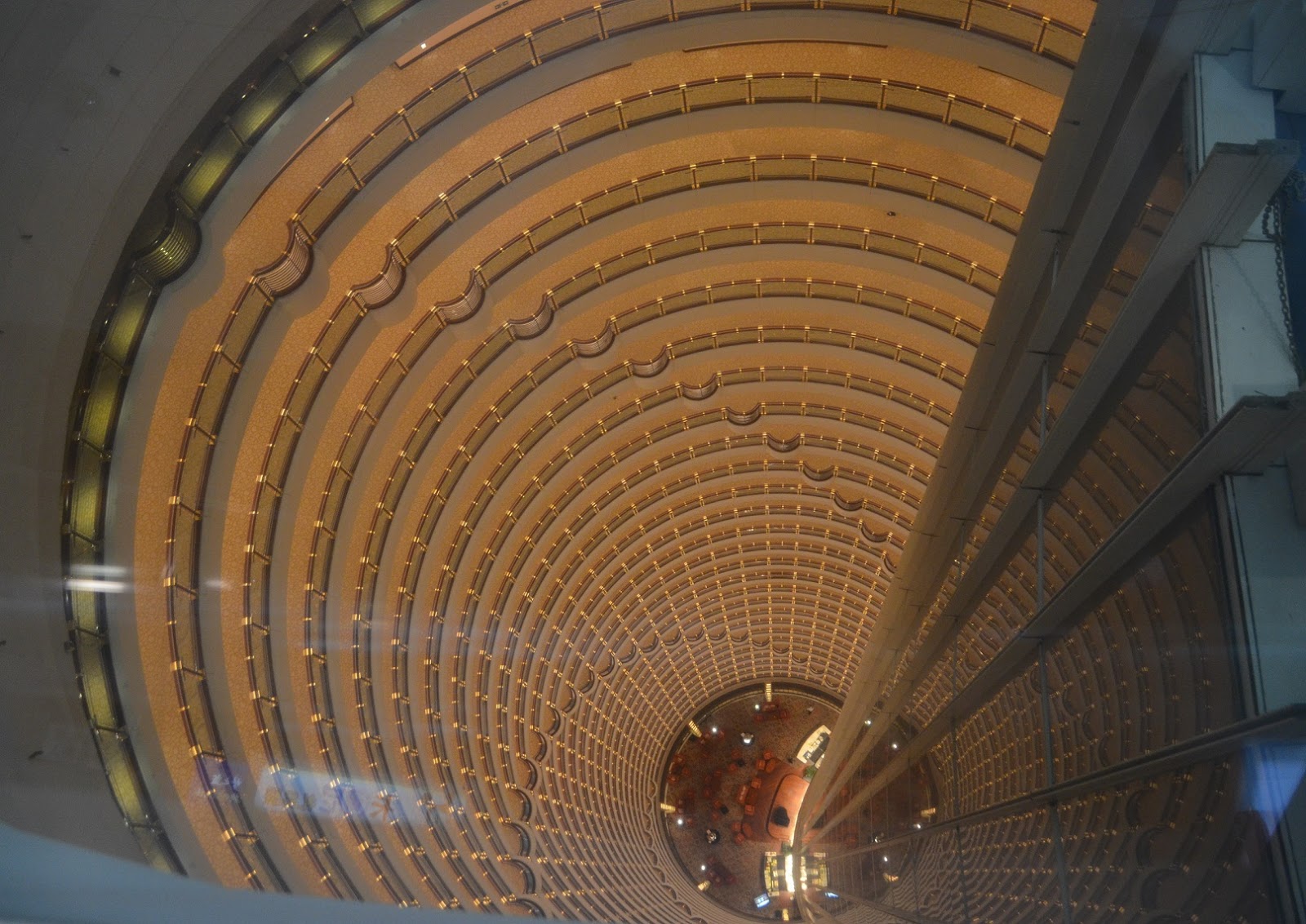
Shanghai boasts the most buildings in China over 28 stories.  The tallest is 127 floors!  We did not go into that one, but we took an elevator to the 88th floor of the next tallest.  The lowest floors are commercial stores, the middle is a Grand Hyatt Hotel, then offices up to the observation level.  some people, not us, walked around the outside of the building, wearing safety harnesses.  We did not actually see anyone doing that, but the view was great, except for the haze.  There were tall buildings as far as you could see in every direction.
The tallest building, the Shanghai tower


Looking down from the 88th floor to
the Marriott lobby on Floor 53.


The Chinese and the Shanghai people love their flowers!  Flowers, shrubs, and smaller trees were in every median and embankment along every road.  It is impossible to take pictures of any of the sculptures and flower beds from the bus.  I have tried.  The bus moves too fast, the windows are hazy and I always get a reflection, so you will just have to use your imagination for most of them.


They love their dogs, too!

Wednesday, March 7, 2018

Manilla

Almost one third of the crew on the Viking Sun, including the Assistant Cruise Director, are from the Philippines.  Most have been away from their families for at least 7-9 months.  Viking recognized this and made special arrangements.  The bought all the rooms in a local hotel for families who were not from the Manila area and opened the ship for families to visit.  Over 350 family members came aboard to see where their family members worked, to tour the ship and to be reunited, even if only briefly, with their loved ones.  One of the kitchen chefs who is about my size introduced us to her sons, 12 and 16, who were close to Darrell's height.  She was so proud of them.  While they were on board, we were out and about in the city.  It was Hot and very Humid.  Our guide gave us lots of time to rest and made sure we were in shade as much as possible when she was explaining the sights.

There is a monument to one of the national heroes in the fight for Independence, Jose Rizal.  The monument, near the place of his execution for inciting revolution against Spain, is the beginning marker of all roads in the Philippines.  An honor guard is always stationed at its base.


A great deal of Manila was destroyed during WWII, either by the Japanese trying to take the city or by Allies trying to retake the city.  The fortress was among areas hard hit but partially restored.  This area is now a national park, and the police who work there wear uniforms designed to look like Spanish soldiers in the 1800's.  The main gate has  carvings related to the Spanish occupation which lasted over 400 years until after the Spanish-American War.


As part of the surrender terms, Spain sold the Philippines to the US.  Although what the local people wanted was an independent nation, they had to wait almost 50 years before that came true.  Under the US administration (occupation)  there were massive reforms including opening education for all students and work on infrastructure.  Even now, English is the language of education, but spoken English is not stressed.  Most people, upon leaving school could read English, but not speak it fluently.  Like any other language, if you do not use it, you lose it.


In order to get a feel for life under Spanish rule, we toured a typical house of an aristocrat from that time.  Everything was either beautifully restored or donated by people whose children did not want any of that "old stuff" but who were reluctant to sell the items (plus they got a tax write-off.)  You have seen such things in museums, so I'll only show you one scene -- a double bathtub, the smaller one for children, the larger for adults.. Both drained out into open sewers, as did all household waste.


Another gift of the Spanish was the Roman Catholic faith.  Most Philapenos are practicing Catholics.  We were not able to enter the church we saw because it was closed  to us.  Hourly masses are held on Sundays (when we were there) from 6:00 to 11:00. From noon until 3:00 the church is reserved for weddings.  We saw a wedding party waiting their turn for the church in the one church which withstood the WWII bombing.


The Chinese have been trading in this area for centuries, long before Western explorers "discovered" the spices and other riches of the area.  When the Spanish took over and built their fort, all trading came through them.  The Chinese established a settlement on the other side of the river, but were only allowed to trade in the fort if they became Christian.  So they did, in name at least.  Their settlement is still "Chinatown" and is one of the largest in the world.


The national dress of the Philippines has beautiful hand embroidery on extremely fine material.  All this is hand done on the best costumes.


Modern Manila is a large city of about 15 million.  In addition to all I have mentioned, it has the Mall of Asia, largest in Asia, with a dome visible for miles.  The skyline shows skyscrapers and construction cranes.  Despite all this, and maybe because of the speed of the growth of the city, the infrastructure has no kept up.


The day ended with a performance of the Philippine National Folk Dance Company, winner of numerous national awards.  They deserved them.  Just to show you how much influence (or money) Viking has, the troupe performed twice in the Star Theater.  Folk dance performances are extremely popular with the passengers.  The first group packed the theater, so they scheduled a second performance and delayed sailing until they went ashore.  Next they tried having performances in the pool area where people could be seated, stand on an upper deck to watch and/or see it all on a big TV screen.  There was still not enough room for everyone, plus, who wants to sit outside and watch when it is 95 degrees with high humidity?


Sunday, March 4, 2018

Malaysia 1

We have several stops in various parts of Malaysia, often separated by stops in other countries.  One part of Malaysia is on the island of Borneo, and that is where we stopped.  Our docking was at Kota Kinabalu, but the tour took us far inland to the Mari Mari Cultural Center. 


Just as we have old farms or villages where the past is demonstrated, so do many other countries.  In a remote jungle,  5 tribes have each constructed a building to represent their former  way of life.


One house demonstrated making fire by rubbing bamboo sticks and lighting bamboo shavings, another showed the various food and how it was prepared and cooked while another demonstrated using a blowpipe to break a balloon.  They let a volunteer try that, but it took more wind than he had.  Remember that these tribes were once head-hunters.


The reincarnation of a head hunter

The last building was a "long house" which was used for gatherings.  This is where they demonstrated various dances.  All the guided were dressed in original costumes.  One of the dances.  Notice not only the costumes, but the musical instruments.
Since this is a tropical climate with a lot of bugs, sleeping areas are protected by mosquito netting.


Saturday, March 3, 2018

The Nation of Brunei, Abode of Peace

That is the official name of this small country, possibly the richest nation on earth, per capita.  The ocean off the shore of Brunei is lit up, day and night, by oil platforms.  That is one reason, but the other reason is that no one can become a citizen of Brunei unless your parents are citizens of Brunei.  Everyone has a national identity card.  If you are a foreigner working in the country, and there are a lot of these people, you are considered a foreign worker until you have been here 25 years and pass a very difficult exam on the history, culture and laws of the country, only given in the native language.  If you pass, you get a different colored national identity card (pink) and are considered a foreign resident.  Only the third group, native born, are considered citizens.

They get a monthly stipend, free education and medical care and other benefits.  This keeps the population down, or it would if the average family did not have 6 to 8 children.  Under Sharia law, a man may have up to 4 wives, if he can afford them.  He must provide a separate house for each wife and treat them all equally.  If a wife feels slighted, she may sue him.  British law applies to major crimes, but Sharia law governs the day to day actions of the people.  Alcohol and tobacco are forbidden.  No one may even enter a restaurant which is not halal (like kosher, but for Muslims.)  A male and female who are not closely related may not be alone together after dark.  Women wear head scarves, except when there is a reason not to.  Our guide did not wear a scarf because it would interfere with her job as a tour guide using a headset to talk to us.

Old style houses in a Water Village

Our visit started with a trip to the technology museum, but what they really meant was a look at the old way of life in a water village.  I am not sure why the people chose to live this way, but they have build their houses on stilts along the shore.  All the houses are connected by wooden walkways.  In previous times, the house were made of palm branches woven to make walls and to thatch the roof.  They wove cloth, and worked in gold, silver and bronze.  Houses were single room and single story.


The modern houses in the water village are built on cement pilings and are made of wood.  Some of them are 2 story and have several rooms.  Electricity and water are provided.  Many people have television, telephones and internet.  Thousands of people live in these water villages.  they have schools also built on platforms.  However, since these too are made of wood and since the houses are close together, fire is a major problem.  There is a fire station at the land side of the water village with 3 nice fire trucks, but I did not see any fire boats.  Whole sections have been destroyed by fire.  The government will resettle the people on land, but many of them prefer to rebuild on the old foundation.  
Water taxi jetty.  A ride is only a phone call away.


To get from one section of the village to another, you could find your way by a series of walkways, I suppose, but the preferred way to get to another place is by water taxi.   If people have jobs in the city, they take a water taxi to a parking lot and drive into the big town or to wherever they work.


 We were fed a snack of traditional foods at one of the houses in a living room about 20 feet long.  Several generations may live in the same house with separate bedrooms but share the kitchen and living room.


Our last stop, after a water taxi ride back to land, was at the local market where the freshest ingredients are available to the cooks.  As an alternative, vendors also go by boat so you can shop at your doorstep.


Downtown Bandar Seri Begawan, the capital of Brunei has modern buildings, including a mosque with a 24 carat gold dome.


Other religious beliefs are tolerated, but may only be practiced in a house of worship or your own home.