Friday, March 23, 2018

The Unity of Truth

The Sanctuary of Truth is an ambitious project undertaken by a very rich Thai man to highlight the basic concepts of Buddhism, Hinduism, Muslim and Christianity which hold true for all people.  Since 1981 he has been having this huge building built of intricately carved wood.  He has died, but his son is carrying on the work.  It will never be done.  As a section is completed, another older section needs repair.  One pillar is made of ironwood.  Everything else is mahogany or rosewood.


There are no nails in the structure.
Everything is held together by interlocking parts.    Pieces of wood are chosen for the grain.  Several pieces may be nailed together for the carving of a single statue or figure, but when the carving is completed, the nails are removed and the pieces joined by wooden locks, dowels and wedges. 
There are many enemies of this structure --termites, weather, sea breezes and fire.  There is an elaborate fire suppression system, but it
would not take much for all that wood to burn.


There is a master plan and templates for the various parts, but we also saw artists drawing designs freehand.  All the carving is done by hand by hundreds of carvers.  When a piece is completed, it is attached in the appropriate place on the building, either outside or inside the building..


The result is a magnificent work of art using symbols from all four religions.


After our tour we were entertained by a troupe of Thai dancers.  Dancers train from a very young age to develop the flexibility of their hands and fingers.


Our final stop was to see yet another large Buddha and a temple on the highest point in the city, overlooking the city of Pattaya and the ocean.  Notice the long many-headed snake which forms the sides of the stairs.  This is the Naga, a creature important to their religion.  It may have any odd number of heads.


Fresh Fruit, Anyone?

The tropics have a wide variety of fruit not grown in more temperate climates.  Some of them are available, but they are never as good after traveling thousands of miles.  We had a chance to see how many of them grow and to taste them, fresh from the field.
Fruit grown on this farm


The "King of Fruits" is durian.  Unfortunately it has a reputation of reeking, especially if it is not fully ripe.  It is not allowed on public transportation and is only sold in the market cut up and well wrapped in plastic.  The exterior is covered with sharp spines.  There is even a law forbidding attacking anyone with a durian.  The severity of the penalty depends on how many of the spines break off.  The fruit we tasted was not smelly and had the consistency of custard.  Actually, it was quite good.


The "Queen of Fruits" is mangosteen.  Unfortunately, they are not ripe this time of year.  However, we did see small green ones which had fallen off the tree.  By looking at the blossom end and counting the petals, you can tell how many seeds the mature fruit will have.  The fewer the seeds, the better the fruit.  The fruit on the left would have 5 seeds; the one on the right would have 7.


The only fruit I was not familiar with was the salaka, a purplish-brown fruit shaped like a water drop with bumps.  They grow in clusters and have one or two large seeds within a sweet flesh.  The sweet ones we had at the farm had brownish flesh and were sweeter than the white fleshed ones we had on the ship.


Our fruit buffet had pineapple, banana, guava, rose apple, green papaya, papaya, mango, dragon fruit and pomelo.  They also served mango, star fruit, longans and rambutans. (not pictured).  Everything was delicious!

Thursday, March 22, 2018

The Other Cambodia

When we were in Cambodia a few years ago, we saw Siem Reap, a big city, Phnom Penh, the capital, and one small village.  The village was small and poor, but neat.  At Siem Reap we stayed at a luxurious resort.  Phnom Penh had a glittering palace and grounds.


 Sihanoukvile, the port where we landed, is poor and dirty, with trash covering the ground.  The fishing fleet we saw hardly seemed seaworthy.


There are fancy new casinos built by the Chinese, but almost no Cambodians can afford to go to them.  Most of the Cambodians can barely exist.  Education is valued, but schools are too expensive for most of the poorer people. Most have no running water, electricity, or sanitation facilities.


Golden Lions are the symbol of the city.  Hopefully they are only gold paint.


The market sold everything from fresh fish to clothing to jewelry.  There may have been more than that, but the smell drove us out.  Several beggars were in the main aisles, either blind or missing legs.  Land mines left over from the civil war are still a problem.


On our way to the temple, we stopped to take pictures of the monkeys on a fence beside the road.


The temple area was clean and well-kept, with
gold statues in addition to the main buildings.

A Land of Contrasts


Vietnam is, indeed, a land of contrasts.  It has the world's second tallest statue of Christ, numerous ornate Buddhist and Hindu temples, but the vast majority of the population claims no religious affiliation.


Roads and streets are lined with shops, usually dirty and messy, but the back half of the building is an ornate 3 or 4 story house built in the local style of narrow and long.


Massive new apartment houses are going up next to fields with thatched roof sheds.


You can travel for miles and miles in Ho Chi Min city on streets lined with small shops and restaurants, but a lacquer workshop and showroom tucked in an alley sells ornate furniture and pictures priced at several thousand dollars.


Freeway medians sport modern art and beautiful plantings.  Other streets an full of potholes, without curbs or gutters.


Tour buses share the road with motor scooters and 3 wheeled trucks.


Masses of wires droop from utility pools  near the Samsung factory.  Our guide could not explain what the wires were for or why there are some on poles and so many just drooping.


Modernistic hotels are just blocks from open fish markets.

Monday, March 19, 2018

This and That

The Sydney Harbor is the highest steel arch bridge in the world, and there is no welding.  The whole thing is held together with rivets.

Slip, Slop, Slap, and Snap.  That is the slogan to encourage kids to avoid getting skin cancer.  Slip on a hat, slop on sunscreen, slap on a hat and snap on sunglasses.


Some things are lost in translation.


I'm a Tunnel Rat

One of the unique features of the Vietnam war was the use of tunnels by the Viet Cong (VC.)  Some of these tunnels have been preserved as a tourist attraction, and, judging from the number of buses in the parking lot, it is a very popular attraction. 

Typical tunnel design.  The arrow shows a ventilation shaft.
A vast system of tunnels were dug into the clay soil in Cu Chi province near Saigon.  There were dead ends, curves, rooms and several layers of caves.  Ventilation shafts came out through old termite mounds.  The entrances were well hidden by leaves, grass and other vegetation.  Some entrances were quite small but others were larger, allowing swift entry.  Some of these have been enlarged to allow easier entry for tourists.

I fit into the entrance....
but I needed help getting out.


The enlarged entrance, steps added.


Once you were in the tunnel with its twists and turns, you had to know which turn led to a room and which led to a booby trap.

The camp had store rooms, work rooms, a kitchen and even a hospital, all underground. The arrow shows the location of the kitchen.  The chimney (see circle) was located far from it, probably farther than in this reconstruction, Cooking was done in the early morning when there was often ground fog.  All this was to keep the airplanes from bombing the kitchens. 


There were bobby traps of several kinds as well as landmines made from unexploded bombs.

At the end of our tour, we saw a video talking about the war from the Vietnamese side.  The peace-loving residents of Cu Chi province had their lives and land ruined by blood thirsty Americans.  Valiant fighters were awarded "American-killer Hero" medals.

However you look at it it caused pain and suffering for everyone involved.  Those who sided with the South were sent to "Re-education Camps."  It is still impossible for them or their children to get good jobs or any government jobs.


Sunday, March 18, 2018

It's Haikou, Not Haiku

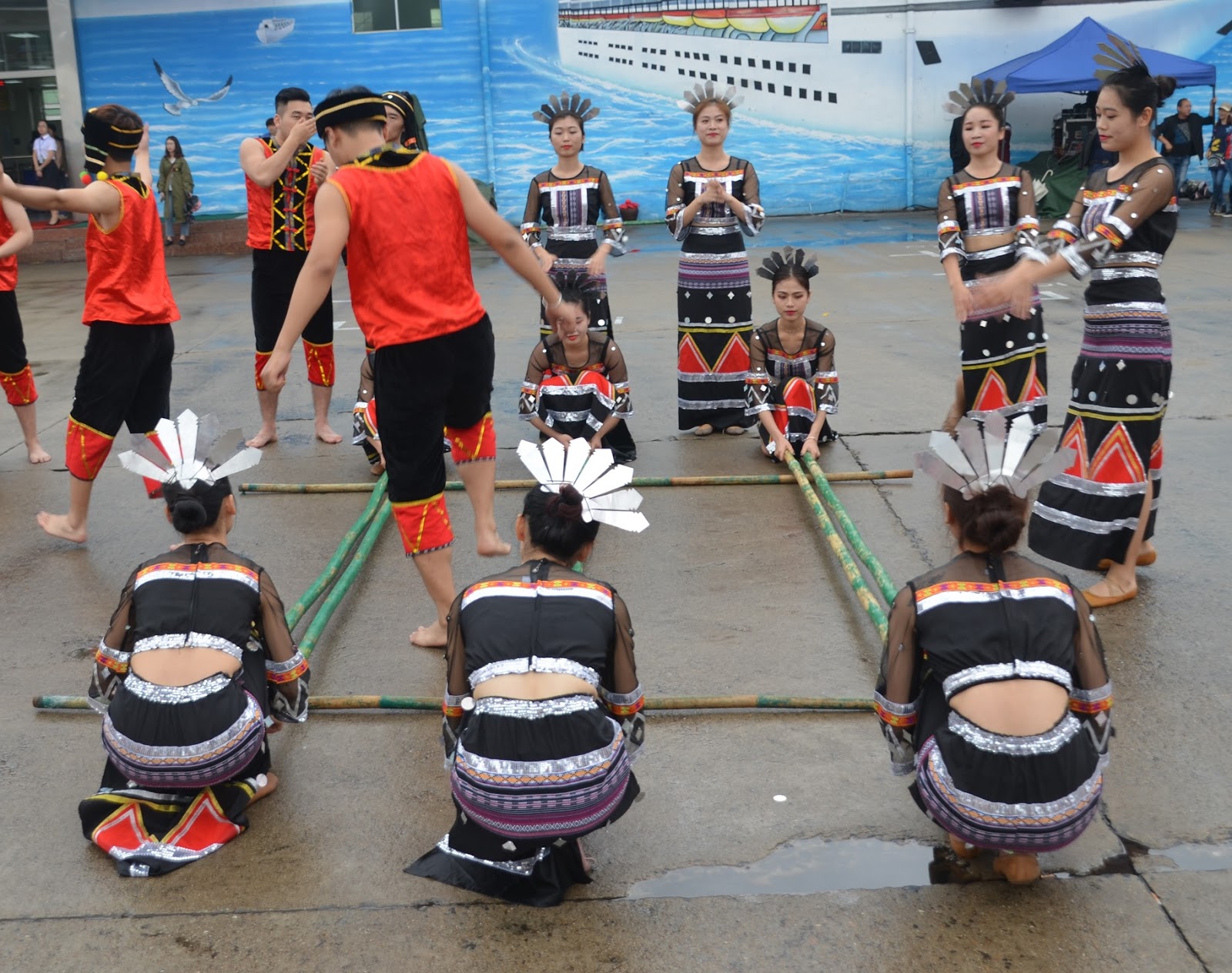
Haiku is a form of Japanese poetry; Haikou is a town at the north end of the southernmost island, Hainan, in China, almost to Vietnam.  We had a warm welcome from the officials, the lion dancers and a group who danced over moving poles.


Not too many cruise ships stop here, so there is a shortage of qualified guides.  Darrell took the included tour of the city with one of the less qualified ones.  The main attraction was the old architecture and shopping.


I made it!


 I had an excellent guide for my tour to the national park around an extinct volcano.  The view was obscured by off and on rain, but the vegetation made for an interesting climb to the rim of the old volcano.  The only drawback was the number of steps it took to get the view down into the volcano.


We were served an interesting meal Chinese style.  The center of the table was a large turntable.  One dish after another was placed on this so each person could dish up some of the food before turning the table so the next person could serve himself.  While we were eating, a troop of dancers performed on the stage which was about 4 feet from our table.  One of the performers, a man I am sure, sang with a soprano voice.


The second part of my tour was at a Mangrove Preservation Park.  We visited a small museum which showed some of the birds, fish and animals that live there.  Then we walked on a boardwalk over the mangrove swamp.  At the end of the walk there was a flock of flamingos from Cuba.  I am not sure why they were there except maybe to show that they liked the habitat.
They danced and fought and preened for a while, then, as if on cue, they all walked off to the back of the pond where we no longer had a good view of them. It was the parade of the flamingos.